
What is Jev AI? System One Models explained – and what they mean for marketing automation
Jev from TypeSafe AI does not generate text, but makes structured decisions – in under 500 milliseconds. What a System One Model means for performance marketing and AI agents.

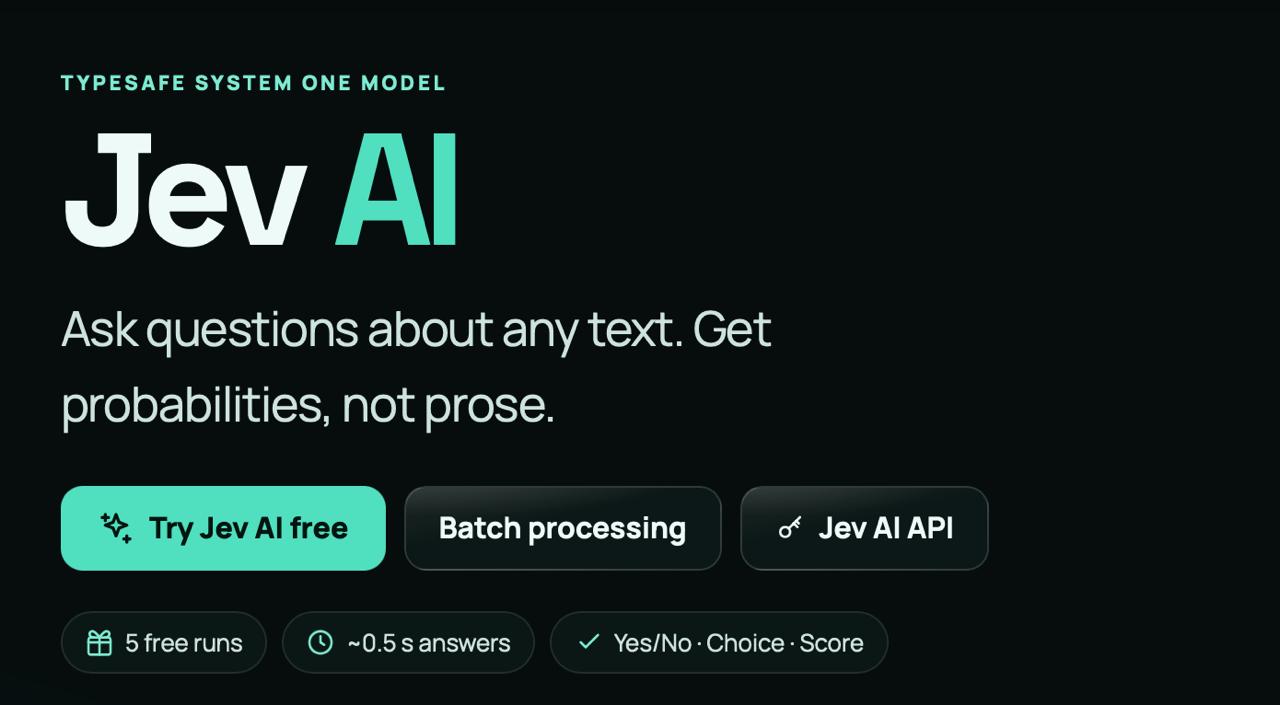
Jev AI at a glance
- Product: Jev
- Vendor: TypeSafe AI
- CEO: Diogo Almeida, formerly a researcher at OpenAI and co-inventor of RLHF
- Funding: 40 million US dollars
- Model class: System One Model
- Available since: 15 September 2026, early access with a waitlist
- Latency: 70 to 500 milliseconds end-to-end
- Price: 0.042 US dollars per million input tokens, output tokens free
- Input: text only – strings, JSON objects, arrays. No images, no PDFs
- Output: a typed decision plus a confidence value, no free text
What is Jev AI?
Jev is a model in the “System One Model” category from TypeSafe AI. It takes unstructured input and returns a typed, probabilistic decision.
TypeSafe describes the model as a function call with frontier intelligence: state in, typed decision out.
Concretely, Jev answers structured questions about a text – yes/no, multiple choice, scoring – and attaches a calibrated probability to every answer. It can evaluate many narrow questions about one and the same state in parallel.
What is a System One Model?
The term refers to Daniel Kahneman’s distinction between fast, intuitive thinking (System 1) and slow, deliberative thinking (System 2).
Classic large language models are, in this logic, System 2 systems: they think sequentially, formulate flexibly and are optimised for open-ended language production. A System One Model is the counterpart – optimised for fast, structured decisions inside software, not for language output for humans.
The decisive difference is the audience: an LLM is built for humans, a System One Model for machines. It does not sit at the end of a conversation, but in the middle of a workflow.
How does Jev work technically?
Two properties distinguish Jev from a classic LLM.
Non-autoregressive sampling. An LLM generates its output token by token; each step waits for the previous one. Jev generates all outputs in a single pass in parallel. That results in the latency of under half a second.
RLCD instead of RLHF. Jev was trained with Reinforcement Learning for Calibrated Decisions. It is not optimised for human preference, nor for verifiable reward, but for epistemically honest probabilities. If the model outputs 80 percent confidence, it should be right in about 80 percent of cases.
Because Jev only chooses from a predefined set of answers, type errors and hallucinated function calls are structurally ruled out. Schema matching is guaranteed.
What can Jev not do?
Jev does not generate text strings. It does not write ad copy, blog articles, chat replies or creative variants. It also does not process images or PDFs.
Jev does not use test-time reasoning. On tasks that require genuine deliberation or multi-step inference, it therefore trails current frontier models. It does not replace a strategy model, but relieves it.
How fast and how cheap is Jev compared with an LLM?
The following figures come from TypeSafe’s own benchmarks and demos. As of September 2026 they have not been independently verified.
- Latency: 70 to 500 milliseconds – according to the vendor, 40 to 200 times faster than frontier LLMs on comparable tasks
- Demo measurement: 0.114 seconds versus 8.566 seconds for GPT-5.6 Terra
- Workflow benchmark: 193.6 times faster and 444.6 times cheaper than GPT-6 Astra and Fable 5.1
- Input price: 0.042 US dollars per million tokens – according to The Register around 238 times cheaper than comparable models
- Output price: free, whereas classic models bill output tokens
- Type errors: a fixed output schema reduces them.
What can Jev be used for?
TypeSafe names as use cases: triage of support tickets, content moderation, routing in chatbots, scoring of reviews, lead qualification, guardrails for LLM outputs, checking of source citations and screening of applications.
In performance marketing that corresponds to the following tasks:
- Comment moderation on social ads – spam, complaint or purchase signal
- Pre-checking creatives against the platforms’ advertising policies
- Assigning leads to segments
- Routing tasks between specialised agents
- Deciding whether an ad set is paused, scaled or left unchanged
- Guardrails before the publication of generated texts
What does this change in the architecture of AI agents?
We operate a team of specialised AI agents that plan, produce, launch and optimize campaigns end-to-end. The consistent observation from this operation: the vast majority of model calls in an agentic marketing system is not text generation, but a decision. An agent produces a manageable number of creatives per week – but every day it makes a very large number of small, recurring classification and routing decisions.
Until now these decisions have run over the same large, slow and expensive models as the text production. That has an architectural consequence that, in our view, is too rarely named: many systems described as autonomous in truth optimize on an interval, not continuously. The reason is not a lack of intelligence in the model, but price and latency per check. Anyone who pays a second and a measurable amount for every check reviews hourly rather than permanently and affords two guardrails instead of ten. If the price per decision effectively falls to zero and latency drops below 100 milliseconds, it is not the speed of the same task that changes. What changes is which tasks are worthwhile at all. Sean Goedecke formulates the same thought more generally: fast software does not only mean doing the same thing faster, but being able to do different things.
A second point concerns compliance. Our compliance agent deliberately works with confidence levels rather than hard blocks, because a compliance check that blocks binarily in practice either lets too much through or stops too much. A model that natively outputs calibrated probabilities fits this logic structurally. A system that honestly states 60 percent certainty is more usable for approval processes than one that confidently gets it wrong.
What criticism is there of Jev?
Three objections are, in our view, substantial.
The technical moat may be thin. Sean Goedecke argues that the core of the approach – instead of generating JSON autoregressively, drawing a token from a fixed set – can be reproduced by any lab with constrained decoding and prefilling. Structured output was previously slow mainly because it received little attention. Anyone who today extracts structured outputs from an existing model already often gains a factor of 2 to 3, according to Goedecke, with better prefilling.
“Does not hallucinate” is a semantic statement. Jev cannot violate the output schema. It can still be wrong within the permitted answer set. A wrong category remains a wrong category. The Register also highlighted this point when classifying the launch.
Lower raw intelligence. Without test-time reasoning, Jev is weaker on anything that requires deliberation than frontier models.
A detail on the side: the name alludes to the Jevons paradox. Efficiency gains historically do not reduce overall consumption, but increase it. The company is therefore implicitly predicting that more tokens will be processed overall, not fewer.
Can Jev be used in a way that is GDPR- and EU-AI-Act-compliant?
As of 20 September 2026, TypeSafe AI makes no solid public statements on hosting region, data processing or data residency. For European advertisers who need a documented processing chain, that is not a side issue, but the first test criterion.
Our assessment: Jev is currently a candidate, not a building block. Anyone considering the model for production should, before using it, obtain a written statement on hosting region and a data processing agreement.
Should you switch to Jev now?
The practically relevant lesson from the launch is vendor-independent and can be applied immediately: deciding and formulating should be separate tasks in an AI stack, with separate models.
Every classification, routing and scoring step that today runs over a large language model belongs on the test bench. In many cases a smaller model with a tight schema and minimal output is enough. You do not need Jev for that – but Jev makes the point visible.
Frequently asked questions about Jev AI
What is Jev AI?
A model from TypeSafe AI that does not generate texts, but delivers structured decisions with calibrated confidence values. In early access since 15 September 2026.
Is Jev an LLM?
No. Jev belongs to the System One Models category. It uses non-autoregressive sampling and does not output free text.
What does Jev cost?
0.042 US dollars per million input tokens. Output tokens are free. In the playground there are five free runs, then one credit per run.
How fast is Jev?
70 to 500 milliseconds end-to-end. TypeSafe says this makes it 40 to 200 times faster than frontier LLMs on comparable tasks.
Can Jev hallucinate?
It cannot violate the output schema and cannot produce type errors. Within the permitted answer options, however, it can decide incorrectly.
Who is behind TypeSafe AI?
The CEO is Diogo Almeida, formerly a researcher at OpenAI and co-inventor of RLHF. The company has raised 40 million US dollars.
What is Jev suitable for in marketing?
For content moderation, lead scoring, creative pre-checks against platform policies, task routing between agents and guardrails before the publication of generated content.
Does Jev replace existing LLMs?
No. It complements them. Text production and strategic deliberation remain the job of classic language models.
Further reading
- Agentic AI in marketing: how autonomous AI agents are redefining campaigns in 2026
- How Google, Meta & Co. steer campaigns autonomously in 2026
- AI adoption in the German Mittelstand
How ADGENTIC's AI agents plan, run and optimise campaigns is explained in the overview of the ADGENTIC agents.
About the author
This article is by ADGENTIC. ADGENTIC is an AI platform for e-commerce performance marketing: specialised AI agents support brand knowledge, creatives, campaigns and media buying. Shopify is coming soon. The company behind it is ADGENTIC Global SA, based in Luxembourg. The assessments of the architecture of agentic systems in this article are based on the ongoing production operation of these agents for European advertisers.
Sources
- TypeSafe AI: Introducing System One Models and Jev – typesafe.ai/blog/introducing-system-one-models-and-jev
- The Register, 16 September 2026: TypeSafe AI debuts model for machines that plays Doom
- Sean Goedecke: Jev means structured output is interesting again
- Jev AI Playground – jev-ai.pro