
ChatGPT Ads fact-check: costs, CTR and conversions
Since OpenAI introduced advertising in ChatGPT in February 2026, LinkedIn posts have piled up: “The next big thing”, “Google Ads are dead”, “Every marketer has to switch now”. I looked at the numbers — and stayed sceptical. Rightly so, as it turns out.

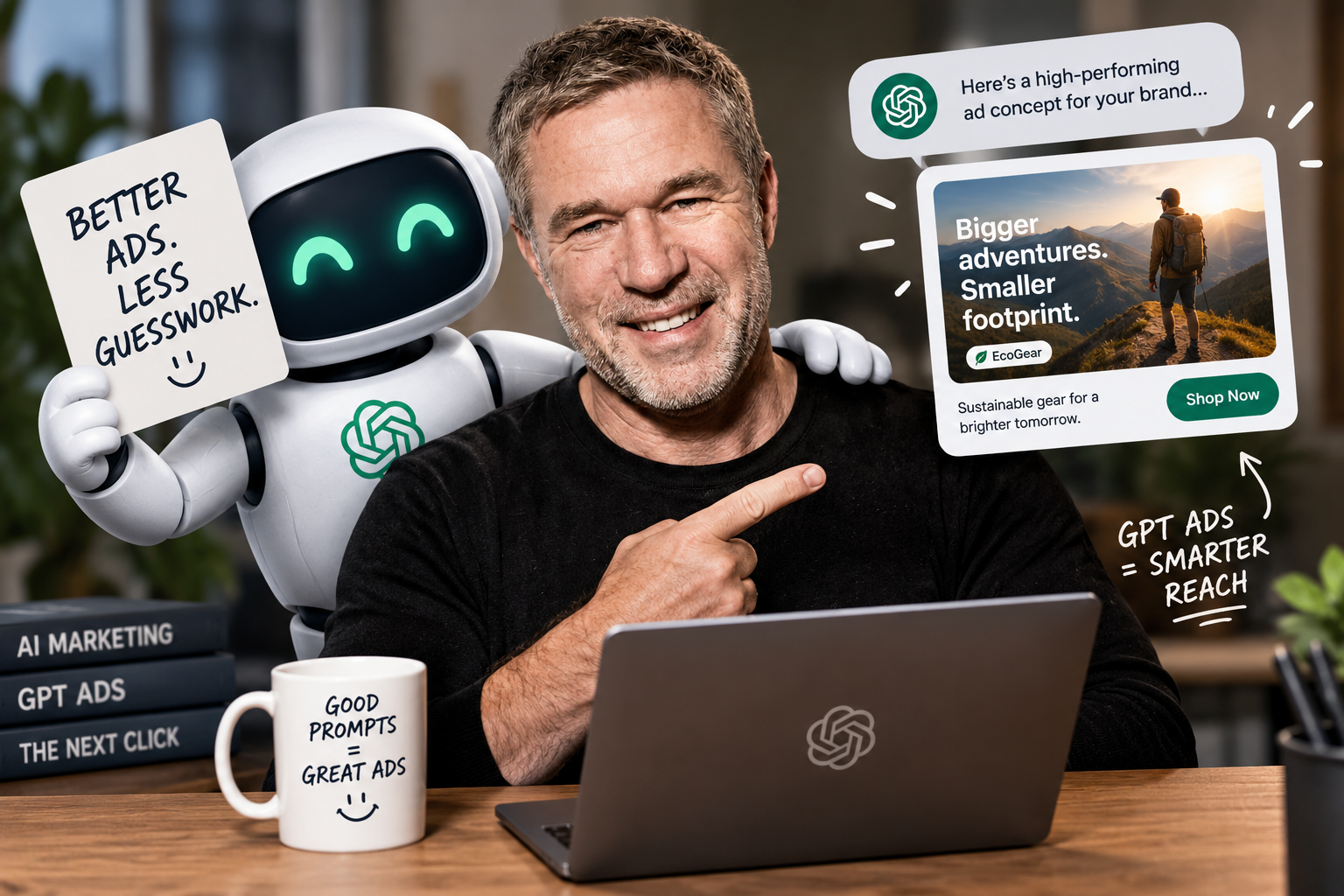
ChatGPT Ads: the next big marketing channel — or just an expensive experiment?
Since OpenAI introduced advertising in ChatGPT in February 2026, LinkedIn posts have been piling up: “The next big thing”, “Google Ads are dead”, “Every marketer has to switch now”. I looked at the numbers — and stayed sceptical. Rightly so, as it turns out.
What do ChatGPT Ads actually cost?
OpenAI started its ads pilot in February 2026 with a $60 CPM (Marketing Brew). At the start, select advertisers were asked to commit at least $200,000, and some were approached for $250,000 (Adweek). Agency partners such as Dentsu, Omnicom, Publicis and WPP support businesses that buy ChatGPT ads (OpenAI).
The price did not stay put. In late April, two agency executives told Marketing Brew that CPMs could clear as low as $15, with $60 now treated as a maximum bid, and OpenAI confirmed it had adjusted the minimum spend (Marketing Brew, 30 April 2026). On 5 May 2026, OpenAI introduced a beta self-serve Ads Manager and cost-per-click bidding (OpenAI). A minimum remains: the standard minimum daily budget in the US is $25 (OpenAI Help Center).
How well do ChatGPT Ads actually convert?
This is where it gets interesting, because the data is thin. A study of nearly 1,900 websites by researchers at WU Vienna and Frankfurt School found a conversion rate of 0.37% for ChatGPT ads versus 1.17% for Google Search ads; 97% of the 87 advertisers using both channels earned less revenue per ChatGPT visit (Search Engine Land, 2 November 2026). The study is observational and may miss later purchases.
Other figures vary widely depending on who publishes them. What stands out: many of the especially positive numbers come from agencies or tools that want to sell ChatGPT Ads campaigns — a classic conflict of interest. Early advertisers said in March 2026 that they could not yet prove the ads work, because mature measurement tools were missing (The Information, via Search Engine Land). Since then OpenAI has added a Conversions API and pixel-based measurement (OpenAI, 5 May 2026).
Why don’t people buy when they use ChatGPT?
That, for me, is the really interesting part — and it has little to do with technology and a lot to do with psychology.
The “fake-friend dilemma” effect.When I search on Google, I know I will get a list of links, some of them paid. That transaction is transparent. When I ask ChatGPT something, I get an answer in the tone of a trusted adviser. If an ad suddenly appears underneath, many users experience that as a breach of trust in the middle of the conversation. Studies of this effect show that people are poor at recognising embedded advertising in conversations — and when they do notice it, trust drops immediately and noticeably.
Advice mode, not buying mode.Someone who asks ChatGPT for the best laptop for their daughter is in an advisory conversation, not in a search engine’s buying mode. The behaviour is closer to brand building than to performance marketing — only it is currently being sold and measured as performance marketing.
Missing data, missing targeting.ChatGPT essentially knows the conversation history and a rough location. It lacks the decades of behavioural and purchase history with which Google and Meta optimise their auctions. Advertisers therefore pay for contextual relevance, not for demonstrated purchase intent.
Paying users don’t see any ads at all.Anyone who pays for ChatGPT Plus or Pro currently does not see ads. That means advertisers tend to reach occasional users on the free plan — not necessarily the most affluent audience.
No comparison mode.On Google I actively compare five offers in five tabs. In ChatGPT I get a synthesised answer and a single, clearly separated ad underneath. Visibility alone does not make a brand the first choice — the actual purchase decision often happens only on the website, and there it is the offer, the price and trust that decide, not the ad placement.
Are Google Ads dead because of this? Not at all.
For a year and a half the search engine has been prophesied a near death, with AI Overviews and AI Mode. Alphabet’s numbers say something else: in the second quarter of 2026, Google Search & Other grew 17% to $63.3 billion in revenue — after more than a year of the AI Overviews rollout. Google’s total advertising revenue was $81.6 billion, up from $71.3 billion in the same quarter a year earlier (Source: Alphabet, SEC filing). Analysts at Wolfe Research spoke of a “resilient environment”; competition from OpenAI has so far been more of a “headline risk” than a revenue problem (Investing.com).
That does not mean nothing is changing. Search volume and click behaviour are shifting, AI-supported tools such as Performance Max are gaining importance. But “dead” looks different. Google Ads remains the channel with by far the most mature data foundation, the largest user volume in genuine buying mode, and a stably growing auction market.
Our position at ADGENTIC
For exactly these reasons we are deliberately taking our time connecting ChatGPT Advertising. As long as reliable data on conversions and revenue per visit stays as thin as it is today, we do not want to put our clients’ budget into an experimental field. Instead we continue to focus consistently on Meta and Google Ads — the channels that demonstrably deliver revenue today. As soon as the picture on ChatGPT Ads changes with reliable data, we will be ready. Until then the rule is: better one channel with substance than ten with hype.
ADGENTIC is an AI platform for e-commerce performance marketing: specialised AI agents support brand knowledge, creatives, campaigns and media buying. Shopify is coming soon. The company behind it is ADGENTIC Global SA, based in Luxembourg.
FAQ
How much do ChatGPT ads cost?
The pilot started in February 2026 with a $60 CPM, and select advertisers were asked to commit at least $200,000 (Adweek, Marketing Brew). In late April, agency executives named CPMs as low as $15 (Marketing Brew). Since 5 May 2026 there is a beta self-serve Ads Manager with cost-per-click bidding, and the standard minimum daily budget in the US is $25 (OpenAI, OpenAI Help Center).
How well do ChatGPT ads convert?
Reliable independent data is scarce. A study of nearly 1,900 websites by researchers at WU Vienna and Frankfurt School found a conversion rate of 0.37% for ChatGPT ads versus 1.17% for Google Search ads; the study is observational (Search Engine Land).
Does ADGENTIC run ChatGPT ads?
Not at the moment. ADGENTIC is deliberately waiting until reliable data on conversions and revenue per visit is available, and focuses on Meta and Google Ads.
Further reading
- Gmail AI Inbox 2026: how AI is changing the business inbox
- Shopify just made every store agent-ready. Now what?
- Meta One: what advertisers need to know now
How ADGENTIC's AI agents plan, run and optimise campaigns is explained in the overview of the ADGENTIC agents.
Sources
- Adweek: OpenAI Confirms $200,000 Minimum Commitment for ChatGPT Ads
- Marketing Brew: OpenAI’s ads pilot is getting more accessible (30 April 2026)
- OpenAI: New ways to buy ChatGPT ads (5 May 2026)
- OpenAI Help Center: Daily budgets
- Search Engine Land (reporting The Information, 23 March 2026): ChatGPT ads pilot leaves advertisers without proof of ROI
- Search Engine Land: ChatGPT ads generate 64% less revenue per visit than Google Search (2 November 2026)
- Alphabet: Q2 2026 results (SEC exhibit 99.1)
- Investing.com: Wolfe Research reiterates Alphabet stock rating on ad strength